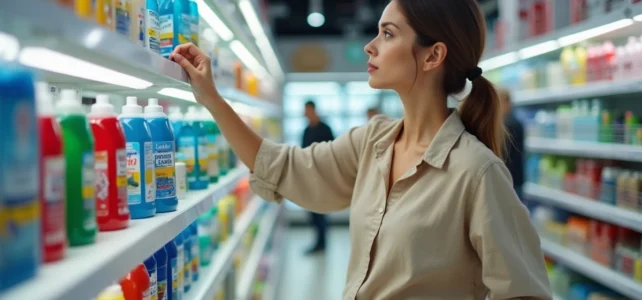
Domestos has gradually disappeared from French shelves, while the product continues to be manufactured and sold in other European countries. This situation is not due to a global production halt, but rather a repositioning of distribution in the French market. Consumers accustomed to this chlorinated toilet gel find themselves facing shelves where the brand no longer appears, without a clear explanation in stores.
Domestos still produced, but absent from the French market
The most widespread misunderstanding is to think that Domestos no longer exists. The reality is different: the brand is still marketed in several countries of the European Union, particularly in Eastern Europe (Czech Republic, Poland, Romania), where complete ranges (Ultra White, Citrus Fresh, Zero Limestone) are sold in supermarkets with detailed product sheets and active customer service.
Professional packaging, such as 5-liter containers labeled “Domestos Original,” is also distributed in Australia for communities and industrial cleaning. Production has therefore not ceased. What has changed is the product’s place in Unilever’s distribution strategy for France.
Several hypotheses are circulating: commercial renegotiations with retailers, a shift towards markets where the brand generates better margins, or adaptation to French regulations on biocides. The available data does not allow for a definitive conclusion between these scenarios, as neither Unilever nor the distributors have publicly communicated on the subject. To understand why Domestos is no longer available, one must look beyond the simple logic of stock shortages.
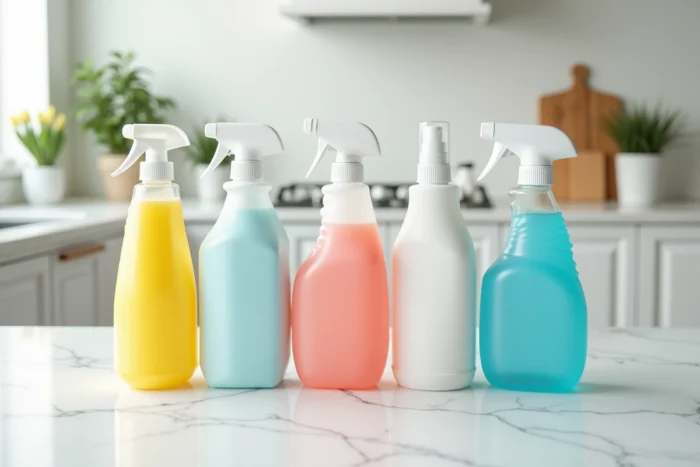
Thickened bleach and chlorinated toilet gels: technical alternatives
Domestos is, from a chemical standpoint, a disinfectant gel based on sodium hypochlorite, in other words, thickened bleach. This formulation allows the product to adhere to the walls of toilets and vertical surfaces longer than regular liquid bleach.
Several brands offer technically equivalent products in the French market. The relevant comparison criterion is not the brand but the composition and viscosity of the gel.
- Toilet gels based on sodium hypochlorite sold by private label brands (Carrefour, Leclerc, Auchan) replicate the same active ingredient, often at a lower price than the original Domestos.
- La Croix, a historic bleach brand in France, markets thickened toilet gels whose active chlorine concentration is comparable to that of Domestos.
- Some professional cleaners available in specialized stores or on B2B platforms offer larger formats and concentrations suited for intensive use (public restrooms, catering).
The point of caution concerns the concentration of active chlorine, generally expressed as a percentage on the label. A toilet gel with equivalent concentration produces the same disinfecting effect, regardless of the brand.
Eco-friendly cleaners versus chlorinated disinfectants: a non-neutral choice
The disappearance of Domestos from shelves coincides with an underlying trend: the rise of household cleaners presented as eco-friendly. White vinegar, baking soda, Marseille soap, or sodium percarbonate are increasingly featured in home maintenance guides.
These solutions deserve to be examined critically. White vinegar is an effective descaler but does not have disinfecting properties comparable to sodium hypochlorite. Baking soda acts as a mild abrasive and odor neutralizer, not as a biocide. Sodium percarbonate releases active oxygen when in contact with hot water and cleans laundry, but its action on bacteria heavily depends on temperature and contact time.
For uses where disinfection is the primary need (toilet bowls, surfaces in contact with wastewater, cleaning after contamination), eco-friendly alternatives do not replace a chlorinated product. However, for regular maintenance of floors, countertops, or windows, they are more than sufficient and avoid exposure to chlorine vapors.
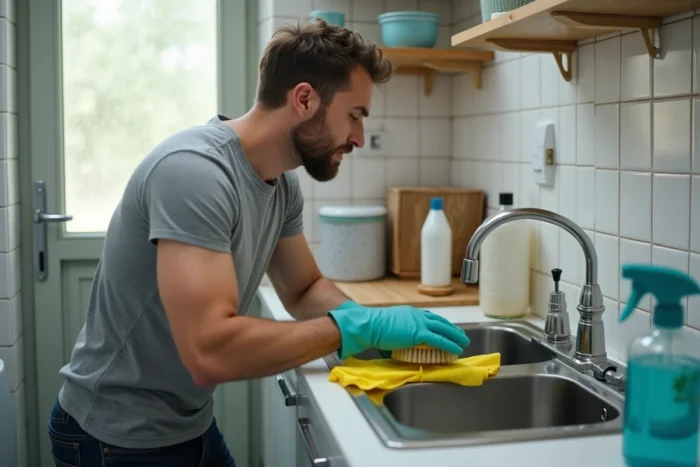
Precautions for use with substitute chlorinated products
Replacing Domestos with another bleach-based gel does not exempt one from following the same safety rules. Never mix a chlorinated product with an acidic descaler (vinegar, hydrochloric acid, descaler): the chemical reaction releases dichlorine, a toxic gas even at low concentrations.
Use in confined spaces (toilets without windows, small bathrooms) requires active ventilation. Thickened toilet gels adhere to surfaces, prolonging contact time but also the release of chlorinated vapors in a small space.
- Wear gloves during application and avoid prolonged contact with skin.
- Rinse thoroughly with water after the indicated contact time on the label.
- Store chlorinated products away from acidic cleaners, including in the storage cupboard.
These precautions already applied to Domestos. They equally apply to any substitute product containing sodium hypochlorite.
The disappearance of Domestos in France is not a shortage in the strict sense, but a withdrawal from the public distribution circuit. Consumers who valued this brand will find identical performance in chlorinated toilet gels sold under other names. The real choice lies between a chlorinated disinfectant, suitable for heavy sanitary use, and gentler maintenance solutions for everyday use. Both meet different needs, and neither replaces the other.