
After an MRI, most patients leave the imaging center without any symptoms. However, some may experience unusual manifestations in the minutes or hours following the exam. Knowing how to distinguish between transient discomfort and a real warning signal helps avoid both unnecessary anxiety and delays in care.
Delayed reactions after gadolinium injection: the forgotten monitoring window
Medical content extensively details immediate reactions to the contrast agent. The window that follows returning home is less documented, even though it concentrates a distinct type of manifestation.
Delayed reactions may occur several hours after gadolinium injection: rash, diffuse itching, or flu-like symptoms (chills, body aches, mild fever). These signs sometimes appear when the patient felt perfectly fine upon leaving the radiology center.
A detailed guide on possible side effects after an MRI reminds us that most of these delayed reactions are benign and resolve spontaneously. The difficulty lies in the fact that the patient is no longer under medical supervision when they appear.
Any isolated rash that subsides within a few hours does not warrant an emergency visit. However, if it is accompanied by facial swelling, respiratory discomfort, or a feeling of malaise, the situation changes.

Non-contrast MRI and contrast MRI: table of possible manifestations
Confusing discomfort related to the exam itself with a side effect of the contrast agent is common. The two situations do not call for the same response.
| Manifestation | Non-contrast MRI | Contrast MRI with gadolinium injection |
|---|---|---|
| Warm sensation | Possible (related to the magnetic field) | Possible (related to the product or the field) |
| Nausea, metallic taste | Rare | Common in the minutes following the injection |
| Headaches | Possible (noise, stress, position) | Possible (contrast agent or stress) |
| Rash, itching | Not expected | Possible hypersensitivity reaction |
| Facial/throat swelling | Not expected | Allergic emergency |
| Fatigue, mild dizziness | Possible (claustrophobia, duration of immobility) | Possible |
Without injection, MRI does not cause a biological side effect per se. Discomfort felt without contrast agent is related to stress or the mechanics of the exam (intense noise, prolonged immobility, confined space of the tunnel). They do not require a medical consultation unless they persist beyond a few hours.
In contrast, any skin, respiratory, or circulatory manifestation after a gadolinium injection should be evaluated based on its severity.
Warning signs after MRI: when to call the doctor or emergency services
The question every patient asks upon returning is simple: is what I feel normal? The triage criterion relies less on the type of symptom than on its intensity and evolution.
Symptoms that justify a call to the radiologist or primary care physician
- Persistent nausea or repeated vomiting more than two hours after the exam
- Unusual headaches that do not subside with a simple pain reliever
- Moderate rash without respiratory discomfort, appearing in the hours following the injection
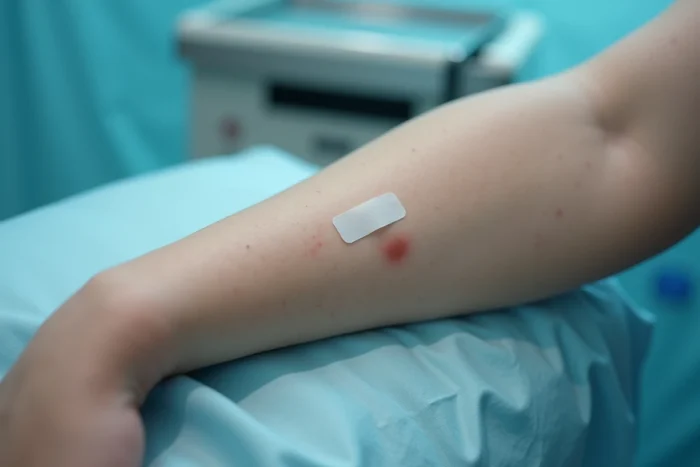
- Pain or swelling at the injection site that worsens (possible sign of contrast extravasation)
Symptoms that are emergencies
- Swelling of the face, lips, or throat (risk of angioedema)
- Difficulty breathing, chest tightness, or wheezing
- Drop in blood pressure with malaise, pallor, or loss of consciousness
- New neurological symptoms: vision disturbances, confusion, weakness of a limb appearing after the exam
A feeling of malaise with respiratory discomfort and throat swelling after injection constitutes an allergic emergency. This type of reaction, although rare, can occur within minutes following the injection or within an hour after leaving the center.
New neurological symptoms after an MRI are not typical side effects of the exam. Their appearance may indicate an underlying pathology revealed by the MRI itself or a temporal coincidence, but they always warrant a prompt consultation.
Renal insufficiency and gadolinium: a specific risk factor
Gadolinium is eliminated through renal filtration. In a patient with normal kidney function, the plasma half-life is approximately 90 minutes. Elimination occurs unchanged, without hepatic metabolism.
In patients with renal insufficiency, this elimination is slowed. The main identified risk is nephrogenic systemic fibrosis, a rare but serious condition affecting the skin, joints, and sometimes internal organs. This risk has led radiologists to adapt their protocols: systematic verification of renal function before any injection in at-risk patients, choosing so-called macrocyclic contrast agents (more stable), and limiting doses.
If you have known kidney disease and notice hardening or thickening of the skin in the days or weeks following an MRI with injection, report it to your doctor without delay.
Extravasation of the contrast agent: a local incident to monitor
Extravasation refers to the leakage of the contrast agent out of the vein into the surrounding tissues at the injection site. It causes local pain, swelling, and sometimes redness at the arm.
In the vast majority of cases, extravasation resolves spontaneously with the application of ice and elevation of the limb. Extravasation accompanied by increasing pain, numbness, or skin color change requires prompt medical advice, as it may compress adjacent tissues.
The distinction between ordinary pain at the puncture site and significant extravasation relies on the evolution: discomfort that decreases within a few hours is reassuring, while discomfort that increases is not.
Keeping a simple criterion in mind helps make the right decision after an imaging exam: any symptom that worsens instead of improving in the hours following the MRI deserves medical advice. In this context, doubt always leans towards calling the primary care physician or the radiologist who performed the exam.