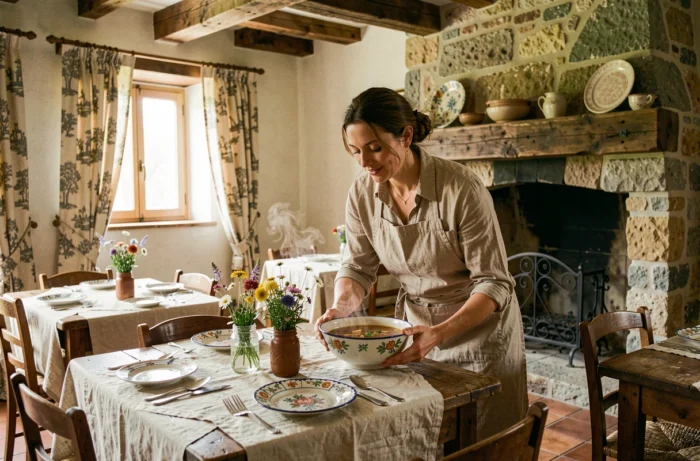
At Marie’s Bistro, the menu changes with the seasons and the products come from identified local suppliers. This positioning, shared by a growing number of rural bistros in France, deserves to be examined from the perspective of what truly distinguishes a country table from a classic restaurant. What concrete criteria allow us to measure the authenticity of a terroir experience in a setting like this?
Privatization and events: a stability lever for destination bistros
Destination restaurant experts have recently emphasized structuring around peak periods rather than continuous opening. For a bistro located in a rural setting, the ability to offer private receptions, seminars, or brand events outside of the high season becomes a factor of viability.
The partial privatization of characterful venues (independent access, acoustic zoning, dedicated restrooms) stabilizes annual activity while preserving the intimate atmosphere sought by regulars. A bistro that reserves part of its dining room or terrace for these uses does not dilute its identity: it enhances it in a different way.
This event-driven approach distinguishes enduring country tables from those that depend solely on summer tourist traffic. At Marie’s Bistro, this type of organization fits within the logic of a place designed to host both a small committee dinner and a larger gathering. To discover Marie’s Bistro on La Fermette De Marie, the proposed setting illustrates this versatility between daily meals and tailor-made events.
Seasonal cuisine and local products: comparison criteria between country bistros
The term “terroir cuisine” encompasses very different realities from one establishment to another. To assess what a country bistro truly offers, several factual criteria deserve to be compared.
| Criterion | Committed country bistro | Classic restaurant |
|---|---|---|
| Menu rotation | Changes according to the seasons (4 to 6 menus per year) | Fixed menu or annual change |
| Product origin | Identified local suppliers, short circuit | Wholesale supply, variable origin |
| Signature dishes | Recipes tied to the local terroir, adapted to arrivals | Standardized recipes, reproducible all year round |
| Setting and ambiance | Vegetated terrace, rural decor, reclaimed furniture | Room arranged without connection to the landscape |
| Connection with local life | Fostering local public, connection with cultural events | Majority passing clientele |
Marie’s Bistro ticks the markers in the “committed” column: the menu evolves with seasonal arrivals, local products are highlighted, and the rural setting directly contributes to the dining experience.
Terrace and rural setting: what makes the difference at the table
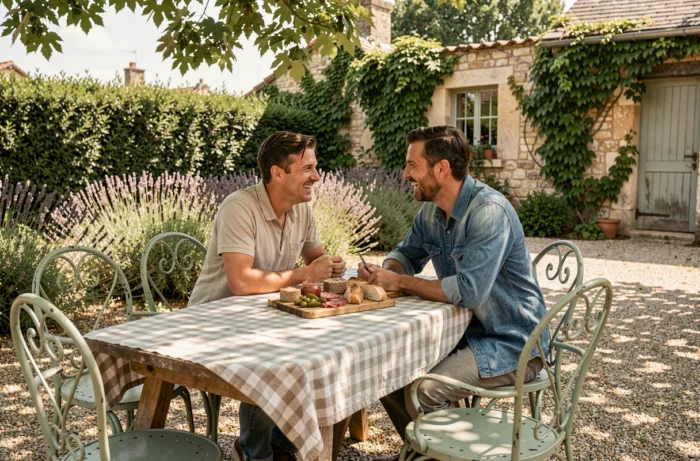
A rural setting is not just a checkered tablecloth. Village bistros that become destination spots share a common trait: the outdoor environment is an integral part of the meal. Shaded terrace, natural vegetation, unobstructed views of a rural landscape – these elements alter the perception of the meal as much as the contents of the plate.
In Saint-Rémy-de-Provence or La Ferté-Macé, bistros located within a village fabric benefit from an advantage that urban restaurants cannot replicate: the continuity between the surrounding area and the dining room. The transition from market to table, from local show to dinner, creates a holistic experience.
- A vegetated terrace allows for outdoor dining without breaking with the surrounding landscape, enhancing the sense of authenticity of the meal.
- The connection with local cultural events (shows, markets, village festivals) anchors the bistro in the life of the territory rather than in a disconnected tourist offering.
- Furniture and decor made from local or reclaimed materials contribute to an ambiance consistent with the cuisine served.
This coherence between the setting, the cuisine, and local life is what separates an authentic country bistro from a restaurant that merely borrows the visual codes of rurality.
Village bistro and local cultural dynamics
An aspect rarely addressed in online reviews concerns the role of the bistro in the cultural ecosystem of its village. In Saint-Rémy-de-Provence, the cultural programming (seasons of shows, associative events) generates a loyal local audience that frequents bistros before or after performances.
This dynamic transforms the restaurant into a place of sociability, not just a dining point. Marie’s Bistro fits into this logic: its clientele is not limited to passing visitors. The village regulars find a landmark there, a place where the table extends collective life.
For a country bistro, this local loyalty is a more reliable indicator of authenticity than online ratings. A restaurant regularly frequented by village residents maintains a consistent level of quality, regardless of seasonal fluctuations in tourism.
Gift boxes and seasonal offers: extending the experience beyond the meal
Some terroir tables offer gift boxes or seasonal offers to extend their activity. These packages allow for transforming a one-time meal into a renewable experience.
A meal box in a rural setting is not comparable to a standard gift voucher. It typically includes the choice of seasonal dishes, sometimes a tour of the estate or a tasting of local products. The offer adapts to the season at the time of booking, not at the time of purchasing the box.
This approach reflects the philosophy of a bistro like Marie’s: each visit is different because the menu, the products, and the rhythm of the place change with the months. The rural setting remains the same, but what is eaten and experienced there depends on the chosen moment.
The constant in this type of establishment remains the coherence between the plate, the place, and the territory. It is this coherence, more than any label or aggregated rating, that defines an authentic dining experience.