Organizing an unforgettable wedding relies less on a big budget than on decisions made at the right time. The couple that anticipates each step, from choosing the venue to coordinating the big day, avoids last-minute compromises. Here are seven concrete keys to structure your preparations without losing track.
1. Keys to organizing an unforgettable wedding

A successful wedding hinges on a clear guiding thread. Before contacting any vendor, ask yourself a simple question: what memory do you want your guests to keep from this day?
This answer guides everything else. If you focus on conviviality, the choice of caterer and entertainment will take precedence. If aesthetics matter, decoration and the venue will come first. Defining a priority prevents scattering energy and budget.
Many couples want to take care of everything equally. In practice, concentrating resources on two or three key areas produces a more striking result than a uniform sprinkling. You can delve deeper into organization on the Rêve 2 Mariage website to identify these priority areas according to your ceremony style.
2. Important tips for calm preparations

The guest list conditions almost all subsequent decisions. Number of covers, size of the room, volume of stationery: the guest gauge sets the perimeter of the wedding. Establish it first, even in provisional form.
Another often underestimated point: communicate early with your loved ones about the format. A wedding over an entire weekend, with a brunch the next day, is increasingly appealing to French couples. The Vows & Venues study by Hyatt indicates that more than one in two respondents wishes to extend the festivities with a brunch the following day.
This format changes the logistics. You need to plan group accommodation, a second meal, and different arrangements for children. Informing guests several months in advance allows them to free up the entire weekend.
3. Essential steps for a well-orchestrated wedding
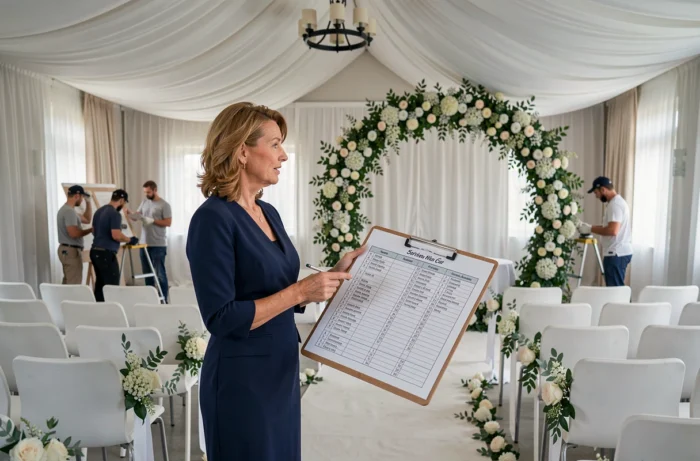
Rather than an endless list, remember three distinct phases:
- Phase 1 (12 to 9 months before): set the date, overall budget, guest list, and book the venue
- Phase 2 (9 to 4 months before): select key vendors (caterer, photographer, musicians), choose outfits, and send invitations
- Phase 3 (3 months to the big day): confirm logistical details, adjust the seating plan, and complete administrative steps at the town hall
Each phase has a critical task that conditions the following ones. In phase 1, it’s the venue. In phase 2, the caterer. In phase 3, the seating plan. Blocking these milestones prevents a domino effect in case of delays.
4. Planning: anticipate rather than endure

Planning is not limited to a retro schedule stuck on the fridge. It involves taking into account your vendors’ constraints, seasonality, and the availability of your closest guests.
Why does this detail matter? Because popular venues are often booked more than a year in advance. If you aim for a summer wedding in a tourist region, start your research as soon as the decision is made.
The couple today finances between 50% and 70% of the budget from their own savings in most cases, with parents providing a supplementary flat-rate contribution. This reality makes financial planning all the more strategic: saving regularly over twelve months is more comfortable than a concentrated effort in the last months.
5. Budget: allocate your resources wisely

The ideal budget imagined by the French significantly exceeds the budget actually spent. This gap in expectations generates frustration when not anticipated.
To stay on track, assign a percentage to each item from the start. The heaviest items are usually the venue, catering, and drinks. Together, they represent the majority share of the total budget.
- Venue and catering: the highest item, to negotiate first to set the financial framework
- Photographer and videographer: a long-term investment, as they are the only tangible memories after the celebration
- Decoration and flowers: an item that can be adjusted according to the style of the chosen venue
- Outfits and accessories: also plan for alterations, often forgotten in the initial calculation
Keep a margin of 5 to 10% for unforeseen expenses. Almost all weddings exceed the planned budget on at least one item.
6. Vendors: choose the right partners

A vendor should not be chosen solely based on their portfolio. Responsiveness, adaptability on the big day, and human compatibility matter as much as the visual outcome.
Meet each vendor in person or via video before signing. Ask concrete questions: what happens in case of rain, what is the backup plan for an outdoor meal, how many weddings are they managing the same weekend?
A good contract details the services, deadlines, and cancellation conditions. Review each clause. Disputes almost always arise from contractual ambiguity, not from bad faith.
For the photographer, ask to see a complete report rather than a selection of ten shots. Consistency over an entire day distinguishes a reliable professional from a talented amateur.
7. Timing: the calendar that makes the difference

Timing is not just about the retro schedule from the previous months. The flow of the day itself deserves meticulous attention.
Plan margins between each key moment. A ceremony that runs twenty minutes over pushes back the cocktail, which delays the meal, which compresses the dance party. Each transition benefits from being timed with a fifteen-minute buffer.
Designate a trusted person (or a professional coordinator) to manage timing on the big day. The couple should not be watching the clock between two embraces. This discreet yet crucial conductor role ensures that the celebration runs smoothly from the first toast to the last piece of music.
The best-organized wedding is one where the couple enjoys every moment without thinking about logistics. A few months of methodical preparation buy this freedom on the big day.