
A fan for less than 50 euros that promises to last all summer is the bet of the Valberg sold at Electro Dépôt. After several weeks of daily use, sometimes more than ten hours a day, the assessment goes beyond just the airflow. The real question is what this fan is worth when the heat settles in for the long haul and the electric meter runs continuously.
Valberg Fan in Intensive Use: What Changes After the First Few Weeks
In the first few days, the Valberg is satisfactory. The airflow is noticeable several meters away, the oscillation covers a good part of the room, and the assembly takes just a few minutes without any special tools.
The difference appears after two to three weeks of sustained use. The AC motor, typical for this price range, heats up more than a DC motor. Specifically, placing your hand on the casing after eight hours of operation reveals noticeable heat. This is not abnormal for an AC motor, but it indicates a lower energy efficiency compared to DC motor models.
Have you ever noticed that a fan becomes noisier over time? On the Valberg, the noise level at maximum speed remains stable. However, at medium speed, a slight buzzing develops over the weeks, likely due to the mechanical play that occurs in the oscillation axis. It’s not a deal-breaker, but it’s a sign of wear that deserves attention.
After publishing our review of the Valberg fan in real conditions, the observation is confirmed: for a device at this price, the mechanical durability remains acceptable, but it cannot compete with fans that are two to three times more expensive.
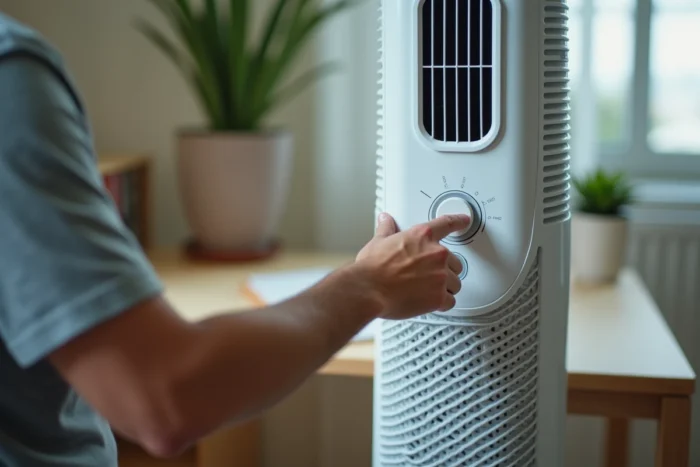
Electricity Consumption of the Valberg Fan: Real Cost Over a Full Summer
The consumption of a fan seems trivial compared to a portable air conditioner. This is true, but over an entire summer, the total is not negligible. The Valberg operates on an AC motor that consumes more than a DC model of equivalent power.
To give you an idea: a standing fan generally consumes between 40 and 75 W depending on the speed. Multiplied by ten hours daily over three months, the bill starts to add up, especially if you run two devices simultaneously.
Optimizing Costs with Off-Peak Hours
Since November 2025, off-peak hours have changed. They are now spread between night and certain afternoon slots. For a fan used mainly at night (the most common case during heatwaves), this distribution is beneficial.
The calculation is simple: running the Valberg during off-peak night hours reduces the cost per kWh. However, you need to check that your contract includes this tariff option. If you use the fan only during the day at peak hours, the savings compared to a small portable air conditioner significantly decrease over time.
- Check your tariff option (base or off-peak) in your supplier’s customer area before summer
- Prioritize nighttime operation of the fan when the rate is lowest and the accumulated heat is highest
- If you use two fans, alternate them to limit mechanical wear and simultaneous consumption
Fan and High Heat: The Health Limits That the Valberg Does Not Address
Here’s a point that most fan tests overlook. A fan does not cool the air. It accelerates the evaporation of sweat on the skin, creating a sensation of coolness. The perceived temperature drop can reach 5 to 6 degrees, which is appreciated in most situations.
The problem arises when the ambient temperature exceeds a certain threshold. Above 35 °C, a fan can accelerate dehydration instead of providing relief. The hot, dry air projected onto the body forces the body to sweat more without sufficient compensation. For the elderly or vulnerable individuals, this mechanism poses a real risk during heat spikes.
What the Valberg Does Well, and What It Cannot Replace
The Valberg, like any classic fan, excels in a temperature range of about 25 to 33 °C. Below that, it is unnecessary. Above that, its use must be coupled with other actions: slightly humidifying the room, closing shutters during the day, placing a damp cloth in front of the airflow.
No fan at this price can replace air conditioning in the event of severe heat. The Valberg provides air circulation comfort, not active cooling. This distinction is crucial for those who rely solely on a fan during extreme heat episodes.

Valberg Fan Against Eco-Friendly Alternatives: Ceiling Fans and DC Models
The fan market is evolving. Ceiling models and DC motor fans are gaining ground, driven by significantly lower electricity consumption. A modern ceiling fan often consumes less than a standing fan while covering a larger area.
The Valberg positions itself as an immediate backup solution: you take it out of the box, plug it in, and it blows. No need for ceiling installation or drilling. This is its main advantage over more sustainable but more cumbersome alternatives to set up.
- The ceiling fan consumes little and circulates air continuously but requires a fixed installation and a ceiling that is high enough
- DC motor fans offer quieter and more economical operation, at a purchase price two to three times higher
- The Valberg remains relevant as a temporary or supplementary solution, not as a primary long-term equipment
For a studio or a spare room, the Valberg fulfills its role for two or three summers. For intensive daily use over several years, an investment in a DC model or a ceiling fan pays off through reduced consumption and superior motor durability.
The Valberg fan keeps its basic promise: to circulate air for a minimal budget. Its limits become apparent over time, both in consumption and comfort beyond 35 °C. Keeping these two parameters in mind before purchase avoids disappointment when the heatwave really sets in.