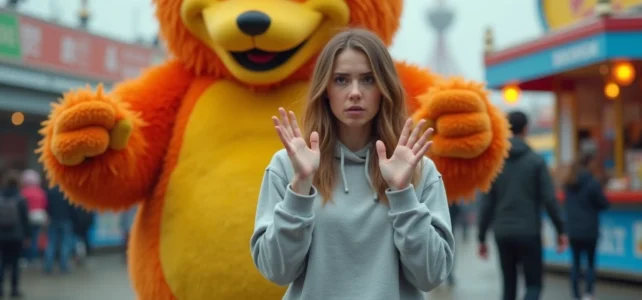
The fear of mascots is not listed in any diagnostic manual as an autonomous entity. It falls under the category of specific phobias related to costumes and masked faces, just like coulrophobia. This nosographic proximity explains why clinical literature documents it so little: it is absorbed by broader categories, complicating targeted management.
Diagnostic classification of mascot phobia in the DSM-5
Specific phobias are divided into subtypes: animal, natural environment, blood-injection-injury, situational, and “other.” The fear of costumed characters falls into the latter category, sometimes linked to the situational subtype when the triggering context (amusement park, sporting event) takes precedence over the object itself.
This classification has a direct consequence on therapy. A practitioner who codes the phobia as “situational” will direct exposure towards places and contexts. A practitioner who codes it as “other” will focus more on the visual characteristics of the stimulus (frozen face, abnormal body proportions, absence of identifiable gaze). We observe that the second approach produces more stable results because it addresses the perceptual core of the fear.
To understand mascot phobia, it is essential to distinguish between the transient developmental fear in children and the established phobia in adults, which persists beyond the stage where the brain should have learned to decode costumes.
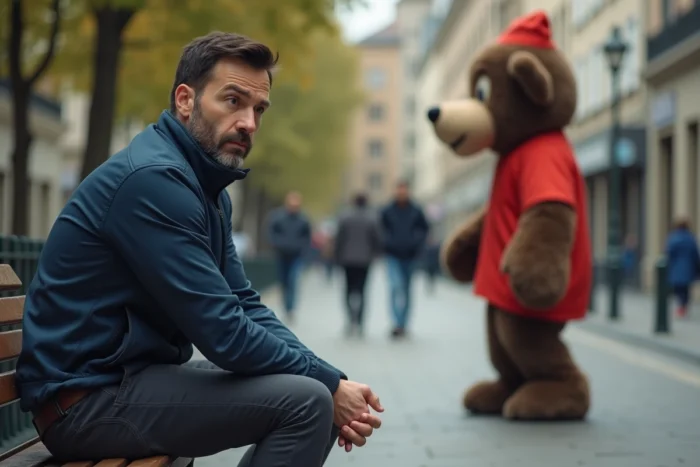
Role of the amygdala and treatment of non-human faces
The amygdala evaluates in milliseconds whether a face is threatening. It relies on precise markers: symmetry of features, mobility of facial muscles, direction of gaze. A mascot ticks all the boxes of perceptual anomaly.
The face of a mascot sends contradictory signals to the limbic system. The overall shape says “human face,” but the immobility of features, absence of blinking, and exaggerated proportions (oversized eyes, fixed mouth) trigger an error signal. This discrepancy between expectation and perception activates a fear response even before the prefrontal cortex can intervene.
This mechanism aligns with the concept of the uncanny valley, originally described for humanoid robots. Mascots occupy a similar perceptual zone: human enough to activate facial recognition circuits, too artificial for the brain to validate identification. The resulting discomfort is not irrational; it reflects a real neuronal conflict.
Why some children develop a phobia and others do not
The reactivity of the amygdala varies among individuals. A child with a low activation threshold will react more intensely to the first exposure. If this exposure occurs in a loud, unpredictable context (a costumed character suddenly appearing in a crowd), the fear response solidifies into emotional memory.
The critical window is between two and six years, a period when the child struggles to distinguish fiction from reality. A mascot approaching too quickly, without the child being able to anticipate contact, is enough to anchor a lasting association between costume and danger.
Viral videos and social reinforcement of mascot fear
Social media has created an unprecedented reinforcement circuit. Compilations of fearful reactions to mascots accumulate millions of views. These contents produce two opposing effects depending on the viewer’s profile:
- For a person without predisposition, the video normalizes fear by making it comical, which can paradoxically lower anxiety through passive desensitization
- For a person already phobic, the visual repetition of the stimulus reinforces conditioning by activating the amygdala without the possibility of real and graduated confrontation
- For a child in the acquisition phase, exposure to these videos can create fear through vicarious learning, even without having encountered a mascot in person
The massive sharing of these contents transforms an individual fear into a cultural phenomenon. The phobia of mascots gains visibility, but this visibility is not therapeutic. It perpetuates the anxious cycle outside any clinical framework.

Gradual exposure protocols adapted to costumed characters
Cognitive-behavioral therapy remains the reference treatment for specific phobias. When applied to mascots, it follows a multi-step exposure protocol, adapted to the fact that the stimulus is a disguised human being and not an inanimate object.
We recommend a hierarchy of exposure that takes into account the perceptual specificity of the problem:
- Photos of mascots with an explanation of the disguise mechanism (showing the person putting on the costume)
- Videos of mascots in motion, first without sound, then with the full sound environment
- Presence in a room with a costume placed on a mannequin, with no one inside
- Observation from a distance of an animated mascot, with the option to leave the room at any time
- Direct and voluntary interaction, having previously seen the person enter the costume
The central point of this protocol is the deconstruction of the mystery behind the mask. As long as the patient (child or adult) perceives the mascot as an autonomous entity, the amygdala continues to code the stimulus as potentially threatening. Showing the dressing process short-circuits this perception.
Limits of desensitization through screens
Watching videos of mascots on a phone does not replicate the real conditions of fear. The format reduces the size of the stimulus, removes the spatial dimension (the mascot cannot approach), and gives the viewer total control via the pause button. An effective exposure involves a partial loss of control, framed by a therapist, which the screen does not allow.
The phobia of mascots remains underdiagnosed because it is perceived as benign. Adults suffering from it simply avoid theme parks and sporting events without consulting. The psychological cost of this avoidance (social restriction, shame, anticipatory anxiety) deserves more systematic clinical attention than it currently receives.