
A couple expecting their first child often receives the same gifts: three giant stuffed animals, five newborn-sized pajamas worn for a week, and no bath thermometer. The baby registry exists precisely to avoid this scenario. When well-constructed, it guides friends and family towards items that parents will actually use, while spreading expenses across multiple budgets.
Fund or product: the choice that structures the entire baby registry
Before browsing the baby gear aisles, one must settle a fundamental question: do we want to receive specific items or rather collect a flexible sum? Both approaches coexist on most platforms, but they do not yield the same result.
The fund is suitable for big items. Stroller, car seat, travel crib: these items exceed the usual budget for an individual gift. Offering a dedicated fund allows each loved one to contribute according to their means, without anyone feeling obligated to finance an expensive item alone.
Individual products work better for everything else. A forehead thermometer, a set of bibs, a developmental book: these are complete gifts that a friend can give all at once. You can also find the baby registry from the site Le Paris des Lardons, which groups ideas categorized by actual use rather than by brand.
Mixing funds and products creates the most functional registry. Reserve two or three funds for the big items and complement with about twenty targeted articles.

Baby registry: filtering items by actual usage frequency
Classifying items by room in the house (bedroom, bathroom, kitchen) creates an orderly list on paper, but does not correspond to the pace of the first weeks. A parent uses some items ten times a day and others once a month. Sorting by usage frequency allows prioritizing purchases that truly matter.
Everyday items to prioritize
Some products are literally used at every diaper change, every meal, every outing. These are the ones that deserve to be at the top of the list, not decorative accessories.
- Cross-over bodysuits in size 1 month (not newborn): most babies outgrow newborn size in a few days, and cross-over bodysuits can be put on without going over the head, which simplifies dressing an infant
- Sleeping bags in two different thicknesses: a sleeping bag suitable for the season replaces blankets and sheets, which reduces risks associated with sleeping
- A set of cotton muslins: makeshift bibs, mattress protection, sunshade for the stroller, muslins are useful for everything and wear out quickly
- Bottle-feeding or breastfeeding equipment depending on the parents’ choice: bottle brush, nursing pads, manual breast pump – to specify on the list to avoid duplicates
What can be removed without regret
The bottle warmer, for example, divides parents. Many end up warming in a water bath or using room temperature water. Feedback varies on this point, but when an item generates so much “we don’t end up using it,” it’s better to leave it off the list and buy it later if the need arises.
The same logic applies to the standing bathtub: practical in a large apartment, cumbersome in a studio. Adapting the list to one’s living situation avoids unusable gifts.
Budget for baby gifts: what loved ones really spend
There is often hesitation about the price ranges to propose. Listing only expensive items discourages colleagues and acquaintances. Only proposing small items frustrates grandparents who want to give a meaningful gift.
Dividing prices into three tiers covers all budgets. The list can be structured as follows: a majority of accessible items (small baby gear, clothing, developmental books), a few mid-range items (baby monitor, bouncer, baby carrier), and two or three funds for big items.
Under French law, a gift given on the occasion of a birth is classified as a present of use as long as it remains reasonable in relation to the donor’s income. There is no fixed legal ceiling. This classification exempts from tax declaration, which reassures loved ones who generously contribute to a fund.
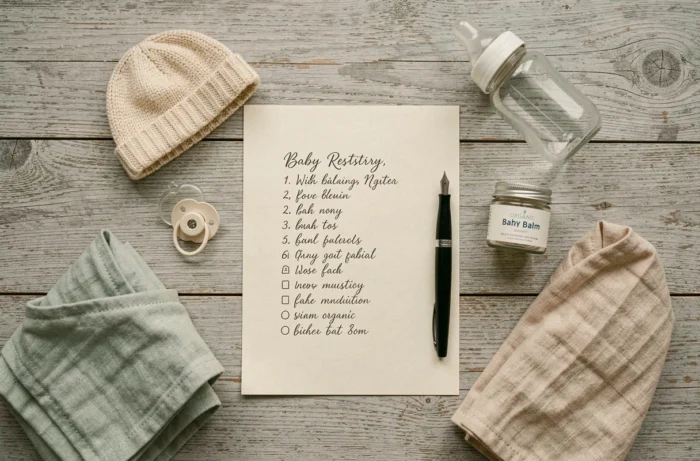
Creating a multi-site baby registry: the duplicate trap
Multi-site platforms allow adding products from any retailer. The freedom is total, but it creates a concrete risk: the same item listed under two different names (at two merchants) can be bought in duplicate by two loved ones who do not coordinate.
To avoid this scenario, check three things before sharing the list:
- Each item appears only once, even if it is cheaper elsewhere – choose a single link per product
- The funds have a specific title (“0+ group car seat” rather than “big items”), so contributors know exactly what they are contributing to
- The list is updated after each confirmed purchase, especially if the platform does not automatically synchronize purchases made outside its ecosystem
A short and well-maintained list is better than a catalog of fifty references. Twenty to thirty items are more than enough to cover the actual needs of the first months. Beyond that, loved ones get lost and end up giving off-list, which negates the whole point of the exercise.
Remember to review the list regularly after its creation: what seemed useful at six months pregnant may not necessarily correspond to actual needs after giving birth. Adding or removing an item along the way prevents ending up with unsuitable equipment.