Have you ever noticed that a recipe calls for “a medium onion” without ever specifying what that means? Depending on the bag purchased, an onion can weigh anywhere from a little to three times as much. The size and average weight of an onion vary according to the variety, season, and packaging. Understanding these differences prevents you from ending up with a soup that is too strong or a bland quiche.
How the diameter of an onion changes your dish
In cooking, the size of an onion affects two things: the ratio between the sweet core and the sharper outer layers, and the cooking time required. A small bulb of 40-60 mm releases its sugar faster in the pan. A large bulb of 60-80 mm retains a crunchy core longer, making it suitable for slow cooking or stuffed onions.
This distinction is not trivial. The size determines the behavior of the onion during cooking, not just its weight. A small-sized onion chopped roughly melts in a tomato sauce in a few minutes. The same weight in large size, cut into wedges, will hold up for an hour in a tagine without falling apart.
To choose well according to your recipe, you first need to understand the average size and weight of an onion as defined by market standards. This is not a theoretical question: it is what allows you to translate “a medium onion” into concrete grams.
UNECE FFV-25 Standard: how onions are sorted before reaching you
Onions sold in Europe follow the UNECE FFV-25 standard. This standard classifies bulbs by diameter, expressed in millimeters. The most common ranges on shelves and in supermarkets are 40-60 mm, 50-70 mm, and 60-80 mm.
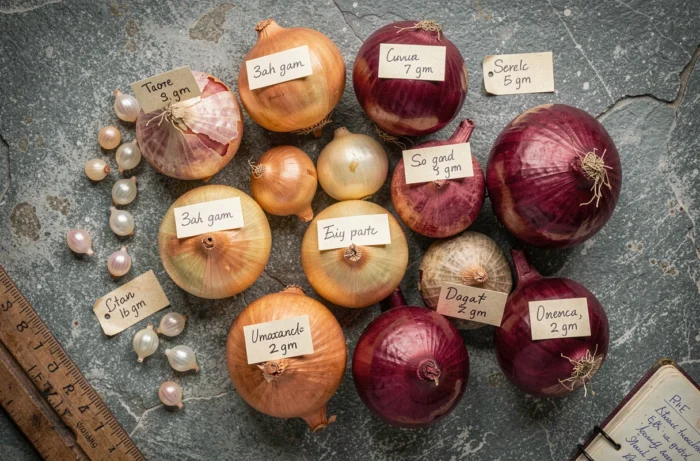
The minimum diameter set by the standard is 10 mm, but in practice, the onions marketed always exceed this threshold. The most useful rule for the cook concerns uniformity: within the same package or bag, the diameter difference must not exceed 20 mm. A bag labeled “50-70” therefore contains onions where the smallest is at least 50 mm and the largest at most 70 mm.
In practical terms, this uniformity guarantees you even cooking if you use several onions from the same bag. No need to monitor pieces that cook at different speeds.
Reading the label on a bag of onions
On a one-kilo bag in size 60-80, you will generally find fewer bulbs than in a one-kilo bag in size 40-60. The number of bulbs per kilo changes, not the total weight. Here are some useful benchmarks:
- Size 40-60 mm (sauce onion or small onion): each bulb weighs relatively little, suitable for whole garnishes, pickles, or stews where individual onions are desired.
- Size 50-70 mm (standard onion): the most versatile size, the one that most recipes refer to as “a medium onion.” Suitable for chopping, soups, and stir-fries.
- Size 60-80 mm (large onion): ideal for stuffed onions, burger rings, or when a recipe calls for a lot of chopped volume without multiplying the bulbs.
Yellow, red, white onion: size doesn’t tell the whole story
Size gives the diameter, but the variety directly influences the density and thus the actual weight. A yellow onion from Auvergne in size 60-80 is firm and dense, with a characteristic coppery skin. A sweet onion of the same size, grown in southern France or Spain, is often juicier and slightly lighter at the same diameter because it contains more water.
The red onion, prized in salads, has flesh that is a bit less tight than the yellow. At the same size, it releases more juice when cooked. If your recipe calls for “150 g of sliced red onion,” go for a bulb of size 60-80 rather than 50-70 to compensate for the water loss.

The shallot, often confused with a small onion, works differently. Its bulbs are more elongated, denser, and their flavor is more concentrated. Replacing two shallots with a medium onion in a wine sauce will not yield the same result, even if the weight seems equivalent.
Adapting onion quantities to your recipes: practical guidelines
The challenge is not knowing how much an onion weighs, but converting that information into a usable quantity. When you chop an onion, you lose the core and sometimes the first outer layer. Expect a loss of about one-tenth of the gross weight during peeling and trimming.
You may have noticed that Anglo-Saxon recipes often refer to “cups”? A 50-70 mm onion, once chopped, fills about one American measuring cup. This visual cue remains more reliable than weight when your scale is tucked away at the back of the cupboard.
Some common equivalents
- A 50-70 mm chopped onion covers the aromatic base of a dish for four people (soup, sauce, risotto).
- For a tart or quiche, two onions of the same size, sliced and melted in butter, are enough to cover a standard pie crust.
- Sauce onions (size 20-40 mm) are cooked whole: count on one handful per person for a beef bourguignon or a roasted garnish.
The current trend in supermarkets shows a greater tolerance for smaller sizes on the shelves. A “medium onion” bought today is sometimes smaller than it was a few years ago. If your dishes seem less flavorful than before with the same amount of onions, simply add one more bulb.
One last point to keep in mind: the season matters. Early onions, harvested before full maturity, are more watery and sweeter. Storage onions, available from September to April, are drier and more concentrated in flavor. At equal weight, a storage onion flavors your dish more than an early onion.