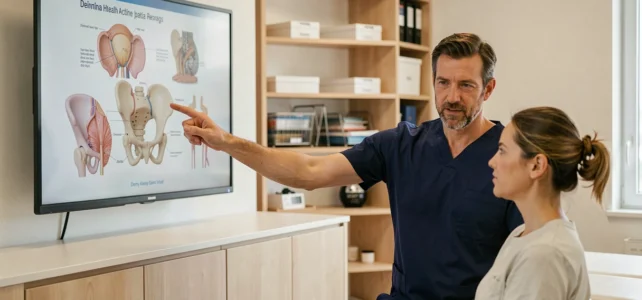
Prostate massage is gaining increasing interest in online research, driven by promises of well-being and pleasure. The articles circulating often mix medical and intimate registers without always specifying where verified data ends. This article sets the factual framework around advanced prostate massage techniques, distinguishing what falls under documented practice and what remains in the realm of personal experimentation.
Prostate Massage and Medical Recommendations: A Documented Discrepancy
Most mainstream content presents prostate massage as a beneficial practice for men’s health. Terms like “drainage,” “decongestion,” or “cancer prevention” frequently appear.
Urological learned societies, both European and North American, adopt a more nuanced position. Prostate massage is not recognized as a standard therapy for chronic prostatitis, pelvic pain syndrome, or erectile dysfunction. There is no solid evidence to justify its systematic use in preventive medicine.
Its primary role remains diagnostic: collecting prostatic secretions for laboratory analysis. It is not a validated method for “deflating” the prostate or preventing cancer. For a man without identified pathology, prostate massage is not medically necessary.
This discrepancy between well-being discourse and official recommendations deserves to be clearly stated. Exploring advanced prostate massage techniques first requires understanding this limit, to approach the practice with informed knowledge rather than based on unsubstantiated therapeutic promises.

Internal and External Prostate Stimulation: What Each Approach Involves
Two access routes coexist, and they do not involve the same gestures or precautions.
External Stimulation via the Perineum
The perineal area, located between the scrotum and the anus, allows for indirect stimulation of the prostate without penetration. Pressure applied to this area can generate diffuse sensations. This approach has fewer hygiene constraints and is suitable for those who wish to explore prostate stimulation without crossing the threshold of anal penetration.
Field reports vary on the intensity of sensations obtained through this route. Some men describe subtle pleasure, while others perceive nothing notable. Individual anatomical variability plays a role that practical guides often underestimate.
Internal Stimulation: Finger or Dedicated Accessory
The prostate is located a few centimeters from the anal opening, on the anterior wall of the rectum. Internal stimulation allows for more direct contact with the gland. However, it requires a strict hygiene protocol:
- Short, filed nails to avoid any micro-lesions of the rectal mucosa, which is fragile and vascularized.
- Thorough hand washing, wearing latex or nitrile medical gloves is recommended to reduce the risk of infection.
- Use of a water-based lubricant in sufficient quantity, as silicone-based lubricants can damage certain accessories.
- Slow and gentle progression, as any pain signals a limit that must be respected immediately.
The gesture itself relies on gentle and steady pressure, directed towards the front of the body. Light circular movements or maintaining constant pressure are the two most commonly described approaches.
Prostate Orgasm: Between Testimonials and Verifiable Data
Prostate orgasm is presented in many articles as a radically different experience from orgasm obtained through penile stimulation. Descriptions evoke more diffuse, longer sensations, sometimes dissociated from ejaculation.
Clinical data on prostate orgasm remains limited. Medical literature focuses more on the prostate from a pathological perspective (hypertrophy, cancer, prostatitis) than from the perspective of pleasure. Most available information comes from individual testimonials and non-academic publications.
What seems established: the prostate contains a high concentration of nerve endings connected to the pelvic nerve network. Stimulation of this area can trigger measurable physiological responses (muscle contraction, blood flow). However, the reproducibility of the experience varies significantly from one individual to another.
Some men achieve a prostate orgasm on their first attempts. Others never succeed despite regular practice. Prostate sensitivity is unique to each anatomy, and no technique guarantees a specific result.
Contraindications and Warning Signs During Prostate Massage
The practice is not trivial and involves situations where it should be avoided. Documented contraindications deserve to be explicitly listed, as they are rarely highlighted with the same visibility as pleasure promises.
- Acute bacterial prostatitis: massage risks disseminating the infection into the bloodstream. Antibiotic therapy remains the standard treatment in this case.
- Presence of prostatic calcifications detected during a medical examination.
- Severe hemorrhoids, anal fissures, or any lesion in the rectal area.
- History of prostate cancer or suspicion currently under investigation.
Outside of these cases, the fundamental rule remains the same: any pain requires immediate cessation of the action. The rectal mucosa does not produce natural lubrication, making it vulnerable to micro-tears if pressure is excessive or lubrication insufficient.
The use of dedicated accessories (prostate massagers) with a flared base is preferable to improvised objects. The flared base prevents the object from migrating into the rectal canal, a real risk that motivates more frequent emergency consultations than one might think.
Prostate massage lies at the intersection of intimate well-being and a medical framework that has yet to produce a consensus on its health benefits. Approaching this practice with factual information, rigorous hygiene, and attentive listening to one’s body remains the only reasonable approach. Promises of spectacular results do not replace caution or, if necessary, prior medical advice.