A living soil, insects that pollinate, plants that protect each other: a natural garden relies on simple mechanisms that are often overlooked. Adopting environmentally friendly practices does not require a complete rethink. A few adjustments are enough to transform a traditional green space into a place where biodiversity can settle sustainably.
Living soil and natural fertility: the foundation of an ecological garden
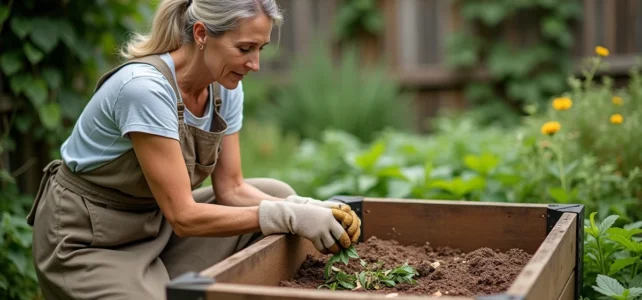
Before planting anything, take a look at the soil. A compact, grayish soil without earthworms indicates an imbalance. Chemical fertilizers nourish the plant, not the soil. In contrast, compost nourishes the microorganisms that make the soil fertile.
Making your own compost with kitchen waste and pruning residues means recycling organic matter on-site. In a few months, the mixture transforms into a rich amendment that improves soil structure, its ability to retain water, and its biological life.
The other crucial action is mulching. Covering bare soil with dead leaves, wood chips, or straw protects soil organisms from drying out and temperature fluctuations. A permanently covered soil also limits the emergence of weeds, which reduces weeding. To delve deeper into these techniques, Jardiner Naturellement’s resources detail methods accessible to both beginners and experienced gardeners.
Labeling your garden as a refuge for biodiversity
Have you ever noticed that some gardens attract many more butterflies or birds than others? It’s not by chance. The diversity of habitats (hedges, water points, wood piles, meadow areas) creates niches where wildlife finds food and shelter.
For a few years now, labels for “biodiversity refuge gardens” have allowed individuals to have their efforts recognized. The principle: commit to a specific set of requirements. Prohibition of phytosanitary products and synthetic fertilizers, obligation to maintain plant diversity, presence of a water point, shelters for wildlife, and sometimes actions to raise awareness in the neighborhood.
Obtaining such a label (offered by the LPO or other associations) is not just a symbolic gesture. It provides a concrete framework that structures practices and offers support. Each labeled garden contributes to a local ecological network, especially in urban areas where private green spaces compensate for the lack of natural corridors.
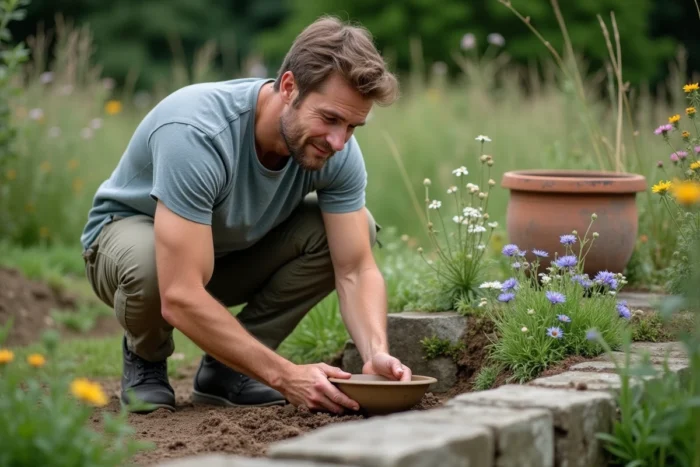
Creating a water point without complicating life
A simple buried container filled with rainwater, with a few stones for insects to climb out, is enough to attract dragonflies, frogs, and birds. There’s no need for a sophisticated pond. A small water point attracts more biodiversity than a flower bed alone.
Saving water in the garden: concrete techniques for collection and watering
Water is the most wasted resource in the garden. Poorly targeted watering, done in full sun, loses a significant amount to evaporation before even reaching the roots.
Three levers radically change water consumption:
- Collecting rainwater in a tank connected to the gutters. This non-calcareous water is better suited for plants than tap water.
- Watering in the evening or early morning, when evaporation is minimal. Water penetrates the soil instead of evaporating from the surface.
- Choosing plants suited to the local climate. Native or Mediterranean species withstand summer droughts much better than exotic horticultural varieties.
Mulching, mentioned earlier, also plays a central role here. A mulched soil retains moisture much longer than bare soil, significantly spacing out watering.
Permeable fences and wildlife movement: an often-overlooked angle
Why this topic? Because most gardens are enclosed by fences, walls, or hedges that block small ground-dwelling wildlife. Hedgehogs, for example, need to travel long distances each night to find food. An impermeable fence condemns them.
Some municipalities, especially in Belgium, now require that fences allow a passage at ground level for small wildlife. An opening of about fifteen centimeters at the bottom of a fence is enough to allow hedgehogs, amphibians, and small mammals to pass through.
Replacing a section of fencing with a wild hedge made up of native species (dogwood, privet, hawthorn) goes even further. The hedge feeds birds with its berries, shelters beneficial insects, and filters the wind. It serves as an ecological corridor at the neighborhood level.
Attracting beneficial insects rather than treating
Ladybugs devour aphids. Lacewings attack mites. Hoverflies pollinate while regulating pests. Instead of looking for a treatment product, even natural, allowing beneficial insects to establish themselves resolves most phytosanitary issues.
To attract them, you need to provide shelter and food. A woodpile in a corner, hollow stems (elder, bamboo) bundled together, areas of unmowed wildflowers: these simple elements create a lasting habitat.
Ecological vegetable garden: combining plants to limit treatments
In the vegetable garden, certain plant associations reduce pest pressure without any inputs. Marigolds planted at the base of tomatoes repel soil nematodes. Basil, in addition to its culinary use, keeps certain harmful insects away from solanaceous plants.
Practicing crop rotation, meaning never replanting the same family of vegetables in the same spot two years in a row, prevents the accumulation of specific pathogens in the soil. This ancient technique remains one of the pillars of a productive vegetable garden without chemical products.
A natural garden does not aim for visual perfection. A few nibbled leaves, an unmowed meadow area, a corner of compost: these “imperfections” are signs of a functioning ecosystem. The most environmentally friendly garden is one that accepts sharing its space with living beings.