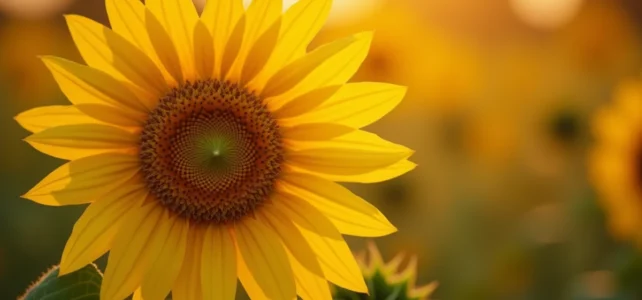
The sunflower occupies a unique place in the collective imagination. Associated with the sun, summer warmth, and good cheer, it is among the most recognizable flowers in the world. However, its symbolism is not limited to joy: it branches out into more complex registers, between personal resilience and tensions related to agricultural models. Comparing these different layers of meaning allows us to measure the gap between its traditional image and its contemporary uses.
Sunflower: Table of Symbolic Registers by Era and Context
The meanings of the sunflower vary according to the historical period and the field in which it is mobilized. The table below juxtaposes the main documented registers.
| Register | Period or Context | Dominant Meaning |
|---|---|---|
| Greek Mythology | Antiquity | Unrequited love, devotion (myth of Clytie and Apollo) |
| Pre-Columbian Civilizations | Antiquity | Sacred symbol of the sun and divine power |
| Victorian Language of Flowers | 19th Century | Admiration, loyalty, fidelity |
| Western Art | 19th Century (Van Gogh) | Vitality, light, emotional intensity |
| Mental Health and Resilience | Contemporary | Individual rebirth, optimism in the face of adversity |
| Ecological Campaigns | Contemporary | Fragility of ecosystems, limits of monoculture |
| Economic Empowerment (West Africa) | Contemporary | Diversification of income, autonomy |
This panorama shows a clear shift. The sunflower has transitioned from a univocal solar symbol to a multi-faceted figure, some aspects of which contradict each other. The same bouquet can evoke pure happiness for one person and remind another of the tensions of the agricultural model.
To delve deeper into the symbolism of the sunflower and its meaning, one must go beyond the decorative register and examine what this flower reveals about our current concerns.
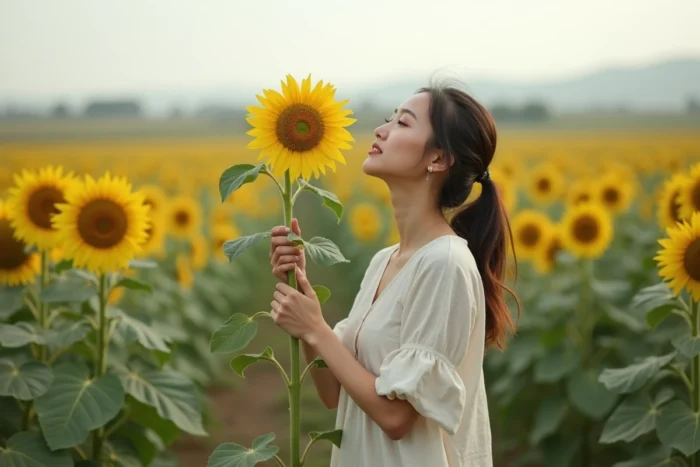
Heliotropism and the Meaning of the Sunflower: Why This Flower Fascinates So Much
The young sunflower follows the sun’s path from east to west, a phenomenon called heliotropism. This botanical peculiarity forms the basis of much of its symbolic charge. Following the light means seeking energy, growth, direction.
In the language of flowers, this ability translates to loyalty and admiration. Giving a bouquet of sunflowers is akin to saying: I turn to you as this flower turns to the sun. The intense yellow color reinforces the message of joy and happiness, while darker red or orange varieties add nuances of passion or intimate warmth.
- The bright yellow symbolizes joy, friendship, and daily optimism
- Orange hues evoke energy, vitality, and warm affection
- Dark red varieties carry a message of deep love, less common than the red rose but equally strong
- The cream white, rarer, refers to purity and spiritual renewal
This palette of colors makes the sunflower a versatile flower in floral language. However, its symbolic use far exceeds the bouquet context.
Sunflower and Resilience: A Symbol of Individual Rebirth
The sunflower germinates quickly, grows tall, and blooms within weeks. This rapid cycle makes it a natural metaphor for rebirth. In the field of mental health, the flower is increasingly used to represent the return to light after a dark period.
Associations and awareness campaigns use the sunflower as an emblem of resilience. The logic is straightforward: a flower that systematically seeks light embodies the drive towards well-being. This symbolic register is relatively recent. It has developed alongside the liberation of speech regarding mental health issues.
The sunflower here acts as a visual shortcut. Its recognizable silhouette and sunny color allow for the communication of a message of hope without the need for words. This is an asset in contexts where verbal expression remains difficult.
Ecological Transition and Agricultural Model: The Ambivalent Face of the Sunflower
The contemporary symbolism of the sunflower is not limited to the individual register. On the collective level, this flower crystallizes tensions that its joyful image does not reveal.
Beekeepers’ and biodiversity advocacy groups mobilize the sunflower to illustrate the limits of intensive agricultural models. The flower, perceived by the general public as an emblem of life and summer, serves in their campaigns to make visible the paradox: sunflower monoculture, combined with pesticide use, contributes to the decline of the pollinators that this same flower is supposed to nourish.
This ambivalence is documented. The sunflower becomes both a symbol of rebirth for landscapes and a marker of fragility for ecosystems. The sunny flower now carries a dual reading, depending on whether it is viewed from the perspective of the passerby or the ecologist.
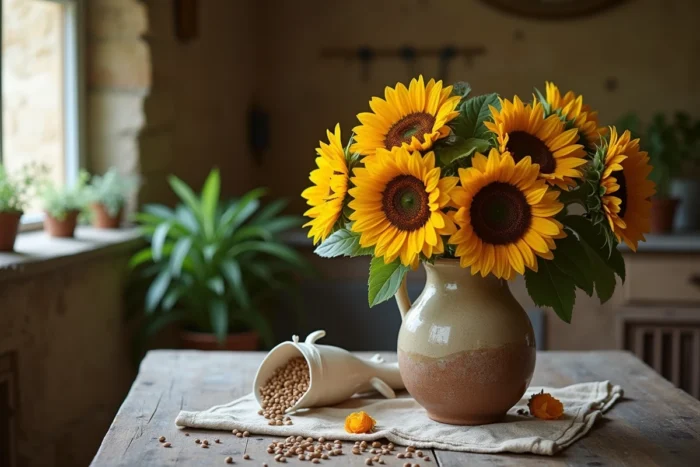
The Sunflower as a Flower of Economic Empowerment
In West Africa, training programs and small oil processing units give the sunflower an additional dimension. For groups of producers, this crop symbolizes income diversification and economic autonomy. The sunflower represents the hope of social ascent, a symbolic layer rarely mentioned in content focused on the language of flowers.
This register of empowerment connects, through another path, to the meaning of rebirth. The flower no longer speaks only of personal optimism: it embodies a concrete lever for collective transformation.
Symbolism of the Sunflower in Art and Culture: Beyond Van Gogh
Vincent van Gogh has fixed the sunflower in the Western artistic imagination. His series of still lifes convey a raw emotional intensity, between vitality and melancholy. The sunflower is already ambivalent here: bright in color, fragile in its wilting petals.
This artistic double reading foreshadows contemporary uses. In post-conflict movements, the sunflower appears as a metaphor for resistance and reconstruction. The flower that grows back on devastated land becomes the image of possible renewal after destruction.
- In contemporary art, the sunflower is used to question the fragility of ecosystems
- In social movements, it serves as an emblem of peaceful resistance
- In art therapy, its simple form and bright color facilitate emotional expression
Thus, the sunflower traverses registers without losing its readability. Its symbolic strength lies precisely in this ability to carry contradictory meanings, from pure joy to ecological awareness, while never ceasing to evoke light. This flower does not reduce to a single message: it reflects, era after era, what each society chooses to project onto it.