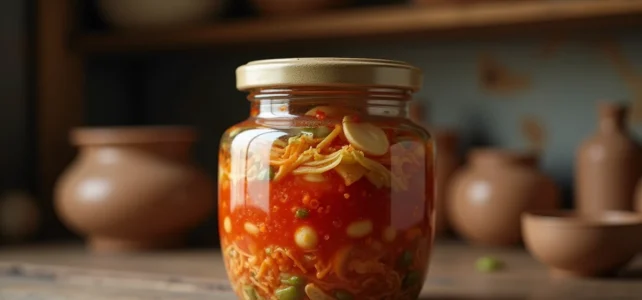
Kimchi is a lacto-fermentation of vegetables, primarily cabbage, in a salty and spicy environment. Botulism, on the other hand, is an intoxication caused by the toxin of Clostridium botulinum, a bacterium that proliferates in anaerobic and low-acid environments. Bringing these two terms together raises a legitimate question: can the conditions for making kimchi promote the development of this bacterium, or do they inherently prevent it?
Lacto-fermentation of kimchi and growth conditions of Clostridium botulinum
Clostridium botulinum requires an oxygen-free environment with a pH above 4.6 to germinate and produce its toxin. Kimchi meets the first condition: the cabbage is submerged in its brine, under a lid, in an anaerobic environment.
It is the second condition that changes everything. Within the first few hours, the naturally occurring lactic acid bacteria on the vegetables begin converting sugars into lactic acid. The pH quickly drops below the threshold of 4.6, sometimes in less than 48 hours depending on the ambient temperature and the amount of salt. Below this threshold, Clostridium botulinum cannot germinate or produce toxin.
Salt plays a complementary role. At the traditional concentration used in kimchi (generally around 2 to 3% relative to total weight), it inhibits undesirable bacteria while allowing lactobacilli to dominate the environment. This double lock (rapid acidity and sufficient salinity) explains why, as shown by the dangers of kimchi according to Mon Blog Cuisine, the risk remains theoretical when the recipe adheres to these fundamental parameters.
| Factor | Critical threshold for C. botulinum | Traditional kimchi |
|---|---|---|
| pH | Growth possible above 4.6 | Drops below 4.6 in less than 48 h |
| Oxygen | Proliferates in anaerobic environments | Anaerobic environment (submersion in brine) |
| Salt | Inhibited at high concentrations | Concentration of 2-3% (partial inhibition) |
| Temperature | Optimal growth between 25 and 37 °C | Fermentation often at room temperature, then refrigeration |
Quick kimchi and low salting: the drift that alters the risk
Recipes for “quick kimchi” or kimchi with very short fermentation are multiplying on social media and in some restaurants. These preparations shorten the fermentation time and reduce the amount of salt, sometimes by half compared to a traditional recipe.
The problem lies in the vulnerability window. A lightly salted and barely fermented kimchi can remain at a pH above 4.6 for several hours, or even several days if the storage temperature is inappropriate. During this period, the anaerobic environment is present, but the acidic lock is not yet established.
This type of preparation is more akin to a marinated vegetable than to a true completed lacto-fermentation. An insufficiently acidified product in a sealed jar creates theoretically favorable conditions for C. botulinum. General articles on the safety of lacto-fermentations claim that the process is safe, which is true for complete fermentation, but does not cover these shortened practices.
Signs of incomplete fermentation
- The kimchi tastes similar to seasoned raw cabbage, without marked acidity, after more than 24 hours at room temperature.
- The liquid in the jar remains clear and does not show the small bubbles characteristic of lactobacilli activity.
- The recipe indicates less than 2% salt relative to the total weight of the vegetables and a fermentation duration of less than 24 hours before refrigeration.
Food botulism in France: which foods are actually involved
Food botulism remains rare in France. The vast majority of cases documented by health authorities involve family or artisanal preserves (canned vegetables, vacuum-packed charcuterie, smoked fish). No cases of botulism linked to kimchi have been reported in official French reports.
This absence does not mean that the risk is zero under all circumstances. It indicates that traditional lacto-fermentation of kimchi, as practiced for centuries in Korea and replicated with the same principles in France, creates an environment hostile to C. botulinum.
On the other hand, the rising popularity of Asian cuisine leads to an increasing production of kimchi in restaurants. Professionals who make their own kimchi on-site are subject to traceability and health risk management obligations, but these regulatory constraints are rarely mentioned in mainstream content on the subject.
Concrete practices for safe kimchi at home
Adhering to a few parameters is enough to keep the risk of botulism as low as possible.
- Use a salt concentration of at least 2% of the total weight (vegetables plus liquid). Measure precisely with a kitchen scale, not by estimation.
- Allow to ferment at room temperature (around 20 °C) for a minimum of two to three days before refrigerating, so that the pH drops sufficiently.
- Keep the vegetables submerged under the brine throughout fermentation to avoid surface mold, which can locally alter the pH.
- Do not simultaneously reduce salt and fermentation time. Decreasing one requires compensating with the other.
Specific case of non-traditional additions
Some recipes incorporate low-acid ingredients like pieces of meat, raw fish, or seafood. These additions raise the initial pH of the mixture and can slow down acidification. For this type of preparation, immediate refrigeration and quick consumption remain the most reliable precaution.
Traditional kimchi, made from cabbage, chili, garlic, ginger, and fermented fish sauce, remains the format with the best-documented safety. Deviating significantly from this base requires understanding the effect of each modification on the acid balance of the jar.