
Choosing a board game for a night with friends often involves consulting lists ranked by the number of players or game duration. These two criteria matter, but they overlook a variable that determines whether the evening will be memorable or tense: the group’s tolerance for conflict, bluffing, and social exposure.
Conflict, Bluffing, and Social Exposure: Three Sliders to Sort Party Games
A group that has known each other for ten years does not react the same way as a table where two people are meeting for the first time. Some party games require lying while looking friends in the eye. Others ask players to mime, sing, or share a personal anecdote in front of everyone.
The group’s level of tolerance for conflict changes everything. TimeBomb, for example, relies entirely on suspicion and accusation among players. Time’s Up forces each participant to expose themselves physically and vocally. In contrast, a cooperative game like The Crew eliminates any direct confrontation.
To explore catalogs that segment games according to these group dynamics, a useful resource is: https://www.lechaudrondesjeux.com/, which allows filtering by mechanics and type of interaction.
Before browsing the shelves, ask yourself three questions about your group:
- Are there players who hate lying or accusing someone, even in a playful context? If so, eliminate pure bluffing games like TimeBomb or Jungle Bluff.
- Are some participants uncomfortable performing in front of others (miming, drawing, improvising)? Then, rule out games with high social exposure like Time’s Up or Happy Salmon.
- Is the group okay with a player being eliminated or targeted? Elimination games can create real tensions in some groups.
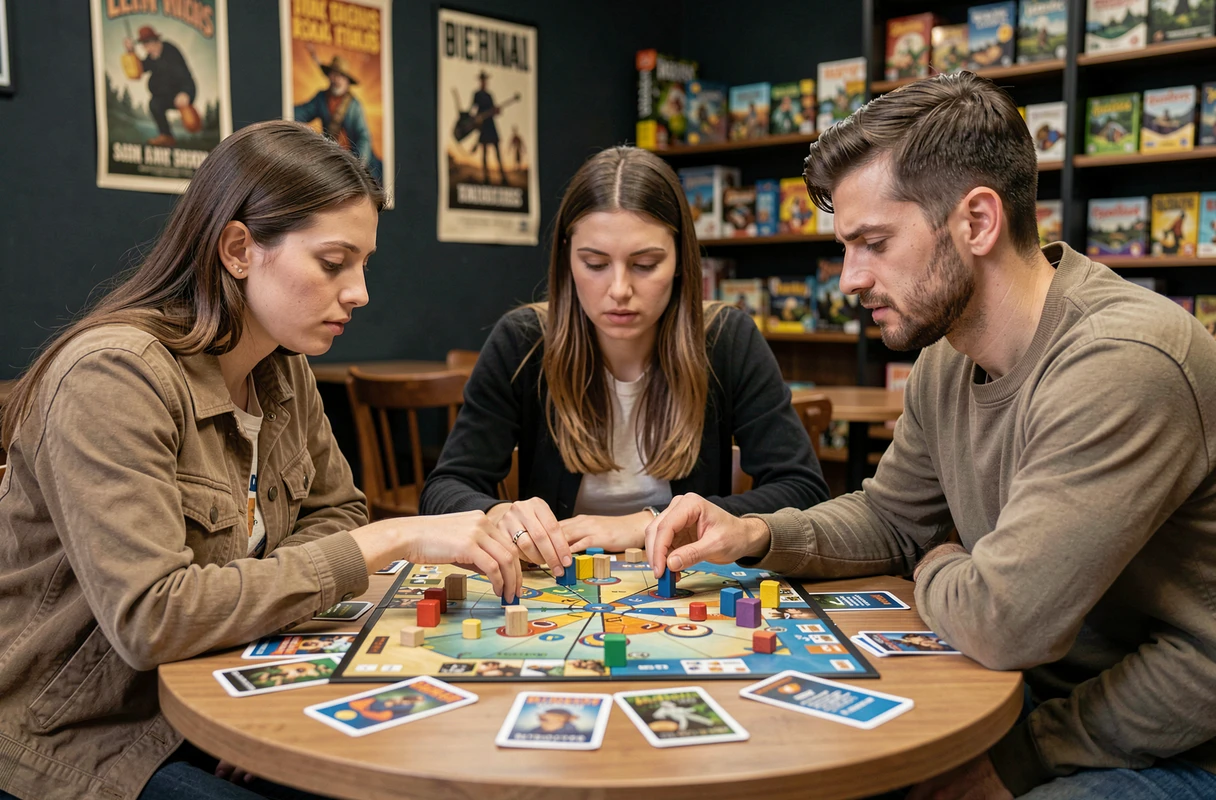
Comparison Table of Board Games by Type of Interaction
The table below ranks several popular party games according to three axes rarely crossed in competing selections: the degree of conflict between players, the level of bluffing required, and social exposure (the need to express oneself physically or emotionally in front of the group).
| Game | Direct Conflict | Bluff | Social Exposure | Ideal For |
|---|---|---|---|---|
| TimeBomb | High | High | Medium | Close-knit groups who enjoy confrontation |
| Time’s Up | Low | None | Very High | Close friends, relaxed atmosphere |
| The Crew | None | None | Low | Mixed groups or new acquaintances |
| Concept / Imagine | None | None | Medium | Players who enjoy guessing without pressure |
| Jungle Speed | Medium | None | Low | High-energy evenings, reflex games |
| Just One | None | None | Low | Large groups, including strangers |
| TTMC | Low | Light | Medium | Trivia fans, gentle competition |
Cooperative games like The Crew or Just One eliminate any source of interpersonal tension. They work particularly well when the group includes people who do not know each other yet.
Bluffing Games Among Friends: Why They Divide as Much as They Unite
Bluffing is the most polarizing mechanic in party games. A player who lies poorly feels ridiculous. A player who lies too well creates distrust beyond the game. Bluffing works when everyone agrees to be deceived without taking it personally.
TimeBomb illustrates this phenomenon well. Its mechanic is simple: hidden cards, secret roles, and the necessity to accuse others to progress. The tension rises quickly, accusations fly, and some players love this pressure while others disengage after two rounds.
In contrast, TTMC incorporates a much lighter dose of bluffing. The player self-evaluates their knowledge level on a topic, creating amusing suspense without direct confrontation. This gentle bluffing suits groups that want fun without friction.
The practical rule: if your group has more than a third of players reluctant to lie, steer the evening towards deduction or cooperative games rather than pure bluffing.
Low Exposure Party Games: Safe Bets for a Heterogeneous Group
The most complicated evenings to host are those that mix very different profiles: regular players and novices, extroverts and reserved individuals, competitors and relaxed players. In this context, low social exposure games reduce the risk of a participant feeling excluded.
Just One operates on a cooperative principle where each player writes a clue in secret. No one has to perform alone in front of the group. The Crew requires silent coordination, which suits players who prefer to think rather than talk.
Concept and Imagine replace words with icons or simple gestures. The active player exposes themselves slightly, but without the pressure of a timer or theatrical miming that Time’s Up imposes.
For groups of seven players and more, favor games where everyone participates simultaneously rather than turn-based games. The wait between turns is the primary factor for disengagement in a large group.
Budget and Testing Before Purchase: An Often Overlooked Approach
Board game selections rarely list a target budget. The most reasonable range for building a party game library is between fifteen and thirty euros per box. At this price, most of the party games mentioned above are accessible.
Before investing in several titles, organizing a first evening with one or two games allows you to gauge the group’s dynamics. A cooperative game at the beginning of the evening (Just One, The Crew) serves as a barometer: if the group gets animated and asks for a challenge, move on to a bluffing game. If the atmosphere remains calm, stick to collaborative mechanics.
Testing a bluffing game and a cooperative game during the same evening reveals the group’s true profile. This information is worth more than any list of recommendations, as it guides you for all future purchases.