The average budget for a wedding in France for around one hundred guests is about 20,000 euros according to Assocem, a threshold that forces couples to rethink every line item of expense. This structuring budget pressure, amplified by rising catering and venue costs, reshapes wedding trends much more than the aesthetic inspirations shared on social media.
Budgetary Decisions: The Real Driver of Wedding Trends 2026
We have observed a clear shift in the hierarchy of budget items over the past two seasons. Couples are no longer cutting uniformly: they are sacrificing certain categories to preserve those that enhance the experience for guests. Heavy decoration is declining in favor of reduced floral installations, sometimes limited to a single variety. The classic seated meal is giving way to partial catering options or food markets, which are less expensive per plate.
Camille Silva Costa, head of Rhône-Alpes at Assocem, confirms that couples are making significant trade-offs on attire, decoration, and entertainment to stay within their budget. This behavior of making trade-offs alone explains why minimalism dominates mood boards: it is not just an aesthetic choice; it is a rationalized financial constraint.
Regional disparities accentuate the phenomenon. The 2026 Wedding Report from Mariages.net establishes a national average budget of 19,293 euros, but the differences between major metropolitan areas and rural zones remain considerable. A Parisian couple and a couple living in a rural area do not face the same pricing structures for a venue or caterer, resulting in weddings with very different formats under the same “trendy” label.
Following the news from Les Mariés de Sylvie allows you to see how these trade-offs are concretely reflected in the collections and services offered to future brides and grooms.
Micro-Wedding and Reduced Guest Count: Impact on Scenography
Reducing the guest list does not simply mean ordering fewer chairs. A wedding of thirty people alters the entire spatial arrangement of the reception. The volumes change, the distances between guests tighten, and the decoration must work on an intimate scale without appearing empty.
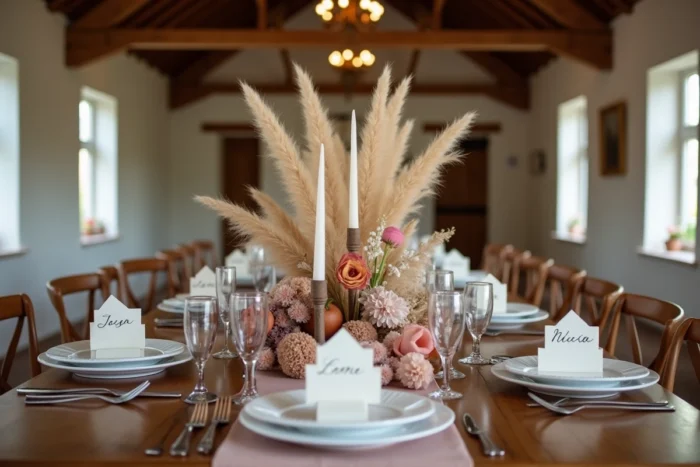
We recommend that couples opting for this format rethink the single table instead of the traditional island seating plan. A single table creates a family meal dynamic that enhances conviviality and eliminates the need for multiple centerpieces, a decorative item often underestimated in terms of cost.
The micro-wedding also changes the relationship with vendors. A photographer adapts their setup: fewer group poses, more spontaneous reportage. A caterer may offer a tasting menu in several courses rather than a buffet. These qualitative adjustments are rarely addressed in mainstream articles, which merely present the reduced format as a “trend” without detailing the operational consequences.
Wedding Color Palette 2026: White Enhanced with Muted Tones
The combination of white and black, inspired by the Bridgerton aesthetic, remains visible on inspiration platforms. However, the field shows a more nuanced palette. Terracotta, sage, and champagne tones dominate requests from florists and specialty stationery makers.
- Terracotta paired with natural linen works particularly well in stone or raw wood venues, without requiring heavy textile draping
- Sage green, featured on stationery and ribbons, provides a botanical coherence without resorting to voluminous floral arrangements
- Champagne is gradually replacing ivory on dresses and accessories, offering a warmer hue in photos without altering the appearance in natural light
These chromatic choices are not disconnected from the budgetary logic mentioned earlier. Muted colors allow mixing suppliers and price ranges without visual disruption, whereas a monochromatic wedding demands absolute coherence among each element.
Bridal Gowns: Noble Fabrics and Streamlined Silhouettes
Duchess satin and mikado are regaining their place alongside lace and tulle, which had largely dominated previous collections. This return to structured fabrics accompanies a trend towards streamlined silhouettes, without layering or excessive trains.
The Bardot neckline, inherited from vintage silhouettes, remains in demand but is now seen on straight cuts rather than princess-style gowns. The result is a dress that is more photographically legible, which does not “get lost” in natural light shots.
- Fluid cuts in silk crepe, worn without a petticoat, reduce visual volume and simplify movement during the reception
- Long organza sleeves replace thin straps, catering to ceremonies at the beginning or end of the season where temperature requires coverage
- Subtle hair accessories (single comb, floral pin) replace crowns and cathedral veils
We note that the romantic bohemian trend is clearly declining in 2026 in favor of a sober elegance, closer to civil attire than ceremonial costumes.
Guest Experience and Reimagined Entertainment
Mobile bars (cocktails, natural wines, artisanal spirits) are taking over from candy bars, which are deemed too sugary and not suited to adult expectations. The cocktail bar is becoming a full-fledged entertainment feature, sometimes with a mixologist who personalizes drinks according to each guest’s tastes.
The phone-free ceremony is gaining ground, supported by professional photographers who find that raised arms from guests spoil aisle shots. More and more couples are imposing an “unplugged ceremony” with a sign at the entrance and the collection of phones.
This approach divides opinions. Some guests view the restriction as a constraint, while others appreciate experiencing the moment without screens. Wedding planners who practice this format recommend limiting the prohibition to the ceremony itself, allowing phones during the cocktail hour and the evening.
The 2026 season confirms that the aesthetic choices of weddings stem from concrete economic and logistical constraints. Couples who succeed in their reception are those who start with the budget and guest count to work their way up to style, not the other way around.